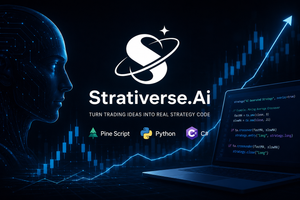

Modern trading requires attention, preparation, and the ability to adapt when market conditions change. For many traders, however, building automated strategies can introduce an additional challenge because traditional systems often require substantial programming knowledge. Strativerse.Ai is designed to simplify this process, allowing traders to spend less time dealing with coding requirements and more time concentrating on strategy development, market analysis, and disciplined execution.
Creating a trading bot through conventional methods can be a demanding process. Traders may need to learn programming languages, build technical connections, troubleshoot errors, and maintain complex systems. Strativerse.Ai aims to reduce these development obstacles through an AI-focused platform that makes automation more accessible. This approach can help users transform trading concepts into structured workflows without making coding the central part of their experience.
Strativerse.Ai recognizes that market knowledge and programming expertise are different abilities. A trader may understand price behavior, technical signals, risk controls, and strategy construction while having little interest in becoming a software developer. By reducing technical complexity, the platform can help traders apply their market knowledge more directly instead of requiring them to master an entirely separate technical discipline.
Time saved on development can be redirected toward strategy research. Strativerse.Ai gives traders an opportunity to focus on defining the conditions that matter to their approach. They can consider when a strategy should become active, what circumstances may indicate an exit, and how risk should be managed. These decisions remain essential regardless of how efficiently a trading system is created.
Strativerse.Ai can also make experimentation more practical. Traders rarely discover a complete strategy on their first attempt. Ideas often need to be tested, reviewed, adjusted, and tested again. When every modification requires extensive coding, this process can become slow. A streamlined automation environment can allow users to explore different strategy variations with fewer technical interruptions.
Speed can be particularly valuable when markets are changing rapidly. A strategy concept may be connected to a specific market environment, but that environment may evolve before a lengthy development project is completed. Strativerse.Ai is intended to shorten the path between strategy planning and automated implementation, giving traders greater flexibility to investigate ideas while they remain relevant.
Consistency is another potential benefit of using Strativerse.Ai. Manual trading can sometimes be influenced by hesitation, excitement, frustration, or fatigue. An automated workflow can follow predefined instructions when specified conditions are satisfied. This does not guarantee favorable results, but it can help traders maintain a structured approach rather than making every decision in response to immediate emotions.
Strativerse.Ai may also reduce repetitive market monitoring. Traders can spend considerable time watching price movements and waiting for particular conditions. Automation can handle suitable monitoring tasks according to established rules. This allows traders to devote more attention to evaluating performance, studying broader market developments, and improving the reasoning behind their strategies.
For experienced traders, Strativerse.Ai can provide efficiency even when coding ability is not a limitation. Skilled developers may still prefer to avoid spending unnecessary hours on repetitive programming tasks. A faster workflow can provide additional time for analyzing data, comparing strategies, reviewing results, and investigating potential improvements.
Strativerse.Ai also reflects the growing influence of artificial intelligence across financial technology. AI-driven tools are making sophisticated processes easier to access without requiring every user to understand the underlying technical details. In trading automation, this development can help shift the user’s attention away from software construction and toward defining clear, logical, and measurable strategy rules.
The concept of focusing on winning should not be interpreted as a promise of guaranteed profits. Strativerse.Ai can simplify automation, but it cannot eliminate financial risk or ensure successful trades. Markets remain unpredictable, and automated strategies can experience losses. Traders must continue to evaluate their assumptions, test their methods, and establish appropriate risk controls before using any strategy.
Responsible use of Strativerse.Ai therefore involves combining automation with careful oversight. Traders should understand what their strategies are designed to do and recognize situations where those strategies may perform differently than expected. Reviewing results and adjusting rules when appropriate remain important responsibilities even when execution has been automated.
Strativerse.Ai can further support traders by making strategy refinement less dependent on technical development. If users identify a weakness or want to experiment with a different condition, a streamlined platform can make adjustments more manageable. This encourages an ongoing process of observation, evaluation, and improvement rather than treating a trading bot as a system that never needs to change.
By reducing the emphasis on coding, Strativerse.Ai can help traders dedicate more energy to the areas where their individual knowledge may provide the greatest value. Strategy design, market interpretation, risk planning, and performance review all require thoughtful decisions. Technology can handle suitable repetitive processes while users remain responsible for the ideas and objectives guiding their automated systems.
Strativerse.Ai represents a broader shift toward accessible trading automation. As technology continues to develop, traders may no longer need extensive programming experience to explore systematic strategies. Strativerse.Ai aims to provide a more direct route from trading ideas to automated workflows, allowing users to focus on creating disciplined approaches rather than becoming consumed by coding. The result is a trading environment where technology supports strategy development while traders remain firmly in control of their decisions.